August 12, 2026 · Aboard Scarlet Lady
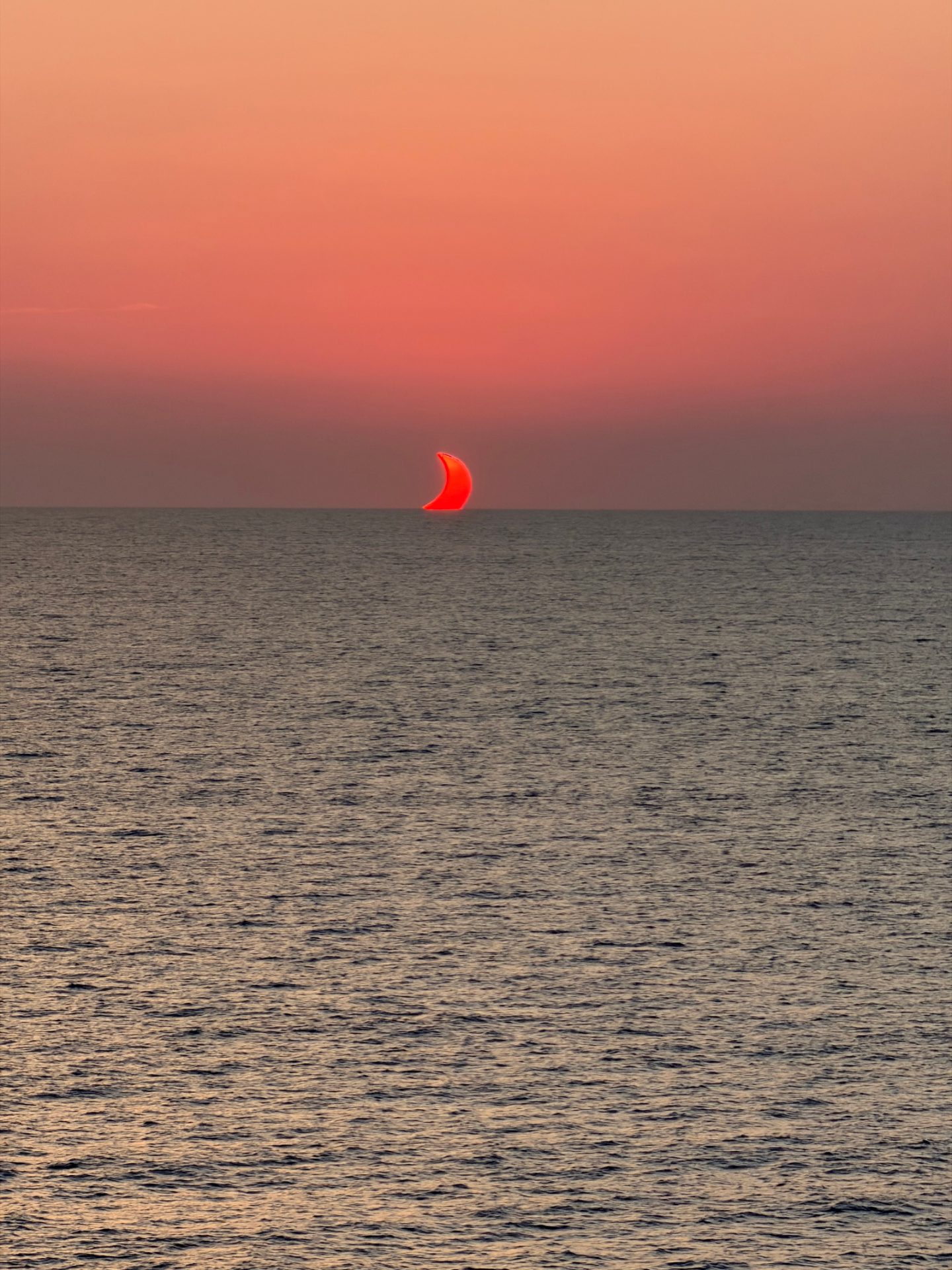
What Actually Happens During a Total Solar Eclipse Aboard Scarlet Lady, and Why Totality Is Rare
A total solar eclipse is the moment the moon passes directly between the sun and Earth and fully blocks the sun's disk from a narrow strip of the planet's surface. On August 12, 2026, that strip crossed the Mediterranean, and I watched it from the stern of Scarlet Lady on Virgin Voyages' Barcelona to Rome sailing after attending two onboard seminars earlier that same day: an eclipse opportunities overview and a full eclipse details briefing, both run by Virgin Voyages' own onboard programming for this voyage.
Key takeaways
- Totality happens because the sun is about 400 times larger than the moon and about 400 times further away, a ratio that lets the moon perfectly cover the sun, a window that will not last forever.
- Total solar eclipses aren't rare, they happen roughly every six months somewhere on Earth. Standing in the actual path of totality is what's rare, since most of that path falls over open water.
- Aboard Scarlet Lady, first contact hit around 7:39pm, totality lasted roughly 70 seconds starting around 8:33pm, and sunset followed 17 to 20 minutes after totality ended.
Why Does a Total Solar Eclipse Happen at All?
According to the eclipse details briefing I attended aboard Scarlet Lady, totality is possible because of a cosmic coincidence: the sun is roughly 400 times larger than the moon, and also roughly 400 times further away. That matched ratio is the only reason the moon can line up and perfectly block the sun from a specific spot on Earth.
A Window That Won't Last Forever
The seminar was direct about this: the 400-to-400 ratio is not permanent. It's a genuinely rare arrangement in Earth's history, not a fixed feature of the solar system. The moon is slowly drifting away from Earth over long timescales, which means this exact alignment is temporary, even if it's stable on any human lifetime.
Why Is Totality Rare If Eclipses Happen Every Six Months?
Total solar eclipses themselves aren't rare. According to Virgin Voyages' eclipse opportunities seminar, they happen roughly every six months somewhere on Earth, because the moon's orbit is tilted about 5 degrees relative to Earth's orbit, and only certain alignments put its shadow where it can reach us.
The Real Rarity Is the Path
What's rare is standing inside the narrow path of totality on the day it happens. Each eclipse traces a different path across the globe, and since most of Earth's surface is water, land-based viewing is often a matter of luck. A cruise ship sidesteps that problem entirely: it can simply be positioned inside the path, which is exactly what Scarlet Lady did on August 12.
What Time Does the Eclipse Actually Happen Aboard Scarlet Lady?
The full eclipse program aboard Scarlet Lady ran from 7pm to 9pm on August 12, with lively countdown viewing on the Athletic Deck (decks 15 and 16) and quiet viewing at the dock on deck 7. First contact, when the moon takes its first visible bite out of the sun, happened around 7:39 to 7:40pm, visible only through eclipse glasses.
First Contact Through the Partial Phase
As the partial phase deepened, the briefing pointed us toward shadow crescents appearing on flat surfaces, a visible sign of the moon's shadow shape even before totality. About 20 minutes before totality, there's a measurable temperature drop and possible shifts in marine bird behavior, both called out in the seminar as things to actually watch for, not just background trivia.
The Final Seconds Before Totality
About 5 seconds before totality, the diamond ring effect appears: the last visible sliver of sun collapsing into one bright point. Just before that, Bailey's beads show up, sunlight breaking through the uneven terrain of the moon's edge in a string of bright points. Both are the visual cue that it's almost time to remove the glasses.
Inside Totality Itself
Totality lasted about 1 minute 10 seconds, arriving around 8:33pm depending on the ship's exact position. According to Nicci Grotefendt, this is the only moment during the entire event when it is both safe and necessary to remove eclipse glasses to see the eclipse directly. During totality, red plasma loops called solar prominences may be visible along the sun's edge, not guaranteed on every eclipse, but possible, and part of what the briefing told us to look for.
After Totality: Sunset and the Perseid Meteor Shower
Once totality ends, every phase repeats in reverse, Bailey's beads, the diamond ring, the partial crescent, all in mirror order. Sunset followed about 17 to 20 minutes after totality ended. The same night, the Perseid meteor shower peaked, and with exceptionally dark skies after the eclipse, the briefing recommended waiting until after midnight, away from ship lights, looking northeast, for the best chance, noting there's even a slim chance of a meteor during totality itself, though that's a separate event best planned for well after midnight rather than expected during the 70 seconds.
What Eclipses Are Coming Next?
The eclipse opportunities seminar also covered what's ahead for anyone who wants to plan around the next one. There's an annular solar eclipse on February 6 next year, a total solar eclipse on August 2, 2027 over northern Africa and Morocco, and a total solar eclipse in 2028 over Australia.
Solar Versus Lunar Eclipses
The seminar drew a clear line between the two eclipse types: a solar eclipse is the moon's shadow falling on Earth, while a lunar eclipse is Earth's shadow falling on the moon, visible in the night sky with a reddish hue caused by Earth's atmosphere scattering red light onto the moon's surface. Worth seeing if the opportunity comes up, but the briefing was clear that it's considered a lesser experience compared to standing inside the path of a total solar eclipse.
FAQ
Is it safe to watch a total solar eclipse without glasses? Eclipse glasses are required any time you look directly at the sun except during totality itself. Aboard Scarlet Lady, totality lasted about 70 seconds starting around 8:33pm, and that was the only window when it was both safe and necessary to remove the glasses to see the eclipse fully.
How long does totality last during a solar eclipse cruise? On this Barcelona to Rome sailing, totality lasted roughly 1 minute 10 seconds, beginning around 8:33pm depending on the ship's exact position at the time. The full eclipse program around it ran from 7pm to 9pm, covering first contact through the return to full sunlight.
Why is a cruise ship a good place to see a total solar eclipse? Because most of the path of totality for any given eclipse falls over open water, land-based viewing depends on being in the right narrow strip. A ship can be positioned directly inside that path, which is what made Scarlet Lady's position on August 12 possible in the first place.
Common Questions
Sail the same Barcelona to Rome eclipse voyage aboard Scarlet Lady.
View Pricing & Book← Back to the Journal